
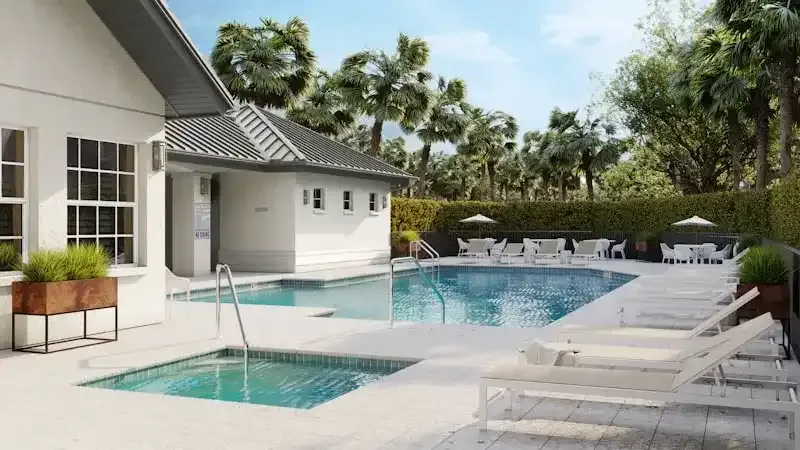
If your Amelia Island home has a pool, you already know it runs nearly year-round. Northeast Florida's climate means pool season on the island stretches from roughly March through November, and even in the cooler months, the water doesn't really get a break. That's the whole story on pool maintenance here. It's not a seasonal project; it's a continuous one.
The upside is that a pool that's maintained consistently is cheap to own. The downside is that a pool that's neglected for a month or two in summer turns into a chemistry problem, an algae problem, or a filter problem, and the recovery cost is significantly higher than the maintenance cost would have been.
Weekly chemistry is the baseline
Pool chemistry on the island runs harder than pool chemistry in drier or cooler climates. High humidity, heavy UV, warm water, and bather load (guests, grandkids, summer houseguests) all push the water toward imbalance. Weekly testing and adjustment is the floor, not the ceiling.
The core tests: free chlorine, pH, total alkalinity, calcium hardness, cyanuric acid. Each has a target range, and each affects the others. Chlorine without stabilizer burns off in UV within hours. pH that drifts up makes chlorine less effective. Alkalinity out of range makes pH unstable. Calcium hardness too low attacks pool surfaces; too high scales up equipment.
For owners who aren't on the island year-round, handling this weekly is either a DIY project on every visit (not practical) or a professional service (standard practice). Most Amelia Island pool services run weekly visits that cover chemistry, brushing, skimming, vacuuming, and equipment checks.
Filter maintenance matters more than people think
The filter is what actually keeps the pool clear. Three common types on island homes: cartridge, sand, and DE (diatomaceous earth). Each has a different maintenance rhythm.
Cartridge filters need periodic cartridge cleaning (every few weeks in heavy use) and replacement every couple of years depending on the cartridge grade and the load it sees.
Sand filters need backwashing when pressure rises above baseline and a full sand replacement every five years or so.
DE filters need periodic backwashing with fresh DE powder and occasional breakdown-cleaning. They filter finer than sand or cartridge but require more attention.
A pool that's running a filter past its maintenance window loses clarity, requires more chemicals, and stresses the pump. That triangle (filter, pump, chemistry) is where most pool problems start.
Algae is the summer adversary
Algae blooms happen when chlorine is low, stabilizer is off, or circulation is poor. In Northeast Florida, the algae risk peaks in summer when water temperatures are highest. Green algae is the easiest to kill. Mustard algae (yellow-brown powder on walls) is harder. Black algae is the hardest.
Prevention is almost entirely about consistent chemistry. Weekly testing, appropriate chlorine levels, proper stabilizer, and running the pump long enough for full turnover every day. Pumps that run short hours (four or five a day in summer heat) invite algae. The rule of thumb is that water should circulate at least once per day, which in peak summer means eight-to-twelve-hour pump runs.
Equipment that wears on the island
Pool equipment on a coastal Florida property has a harder life than equipment inland. Salt-laden humid air, intense UV on exposed pump housings, and year-round operation all shorten equipment life compared to manufacturer expectations.
Pumps typically last 8 to 12 years in good service. Heaters similarly. Salt chlorine generators have cell lives of 3 to 5 years with regular use. Timers, valves, and O-rings are all service-life components. A pool inspection that catches a failing capacitor or a worn pump seal is much cheaper than an emergency replacement mid-summer.
Replacing equipment proactively (when it's showing wear but still working) tends to cost less than replacing it reactively (when it fails on a hot weekend with guests over). Most pool services will flag wear and help schedule replacement on a calendar rather than a crisis.
Preparing for storms
Hurricane season pool prep is its own subset of maintenance. Before a named storm threatens the island, the pool needs to be storm-ready:
- Lower water level 12 to 18 inches to accommodate heavy rainfall
- Shock the pool with elevated chlorine to handle contamination from debris
- Secure or store all loose pool equipment, furniture, toys, and floats
- Don't drain the pool entirely. An empty pool can float out of the ground in saturated soil
- Turn off the pump at the breaker if heavy rain or flooding is expected
After the storm, the pool will likely need a full chemistry reset, a filter cleaning, and debris removal. The faster this happens, the easier the recovery. Pool services and property management relationships that include storm response handle this automatically; homeowners without that coverage should have a clear post-storm plan before the season starts. Read the hurricane season preparation guide for the full property-wide checklist.
Seasonal rhythms
- Winter (December through February): water cools, algae risk drops, chlorine demand drops. Reduced pump hours are fine. Cover use depends on the pool's heating situation. Equipment inspection window for the upcoming season.
- Spring (March through May): water warms back up, chemistry demand increases, bather load starts climbing. Full equipment service. Re-opening procedures if the pool was winterized.
- Summer (June through August): peak season. Weekly chemistry is non-negotiable. Pump runs long. UV is harsh. Algae risk is highest.
- Fall (September through November): cooling water, declining chemistry demand, storm prep for any late-season systems. Post-summer filter service.
A pool that runs on this rhythm costs what pool ownership costs. A pool that doesn't costs more. That's the math. For owners who'd rather have the whole thing handled by someone local, coordinating pool service is exactly what vendor coordination is built for.